


The Puppet Masters
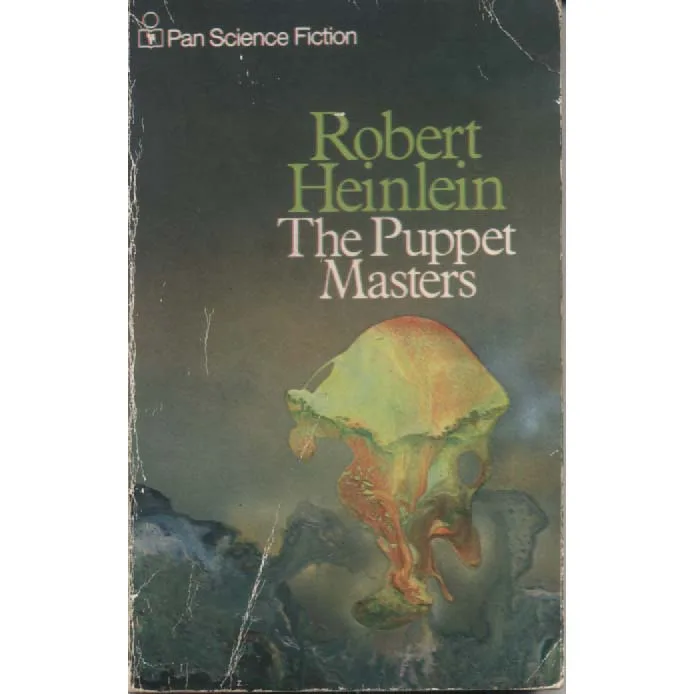
Publisher: Pan Science Fiction
Format: Paperback
ISBN: 0330022350
The Puppet Masters (1973) by Robert Heinlein
Pan Science Fiction
ISBN: 0330022350
Condition: Good
Robert Heinlein’s The Puppet Masters begins with one of science fiction’s most enduringly unpleasant ideas: what if the person standing next to you is no longer entirely in charge of themselves?
And what if the thing in charge is attached to their back?
Originally published in the 1950s, The Puppet Masters is a classic alien-invasion novel in which extraterrestrial parasites arrive on Earth and begin taking control of human hosts. Not by negotiation, not by diplomacy and not with the faintest interest in cultural exchange.
They simply climb aboard.
The result is part invasion thriller, part Cold War paranoia and part very good reason to become suspicious of anyone wearing unusually loose clothing.
The story follows a covert government team investigating reports of strange events and increasingly unsettling behaviour. At first, the situation is mysterious.
Then it becomes obvious.
Then it becomes considerably worse.
The aliens, known as slugs, attach themselves to human beings and take control of their bodies, turning ordinary people into obedient extensions of an invading intelligence.
Which raises a practical problem.
How do you fight an enemy when the enemy looks exactly like your neighbour?
Or your colleague?
Or someone at the Ministry insisting there is absolutely nothing to worry about?
Heinlein uses the idea with ruthless efficiency.
The horror is not simply physical.
It is social.
Trust disappears.
Normal behaviour becomes suspicious.
Anyone might be compromised.
And once that possibility enters the room, civilisation becomes rather difficult to organise.
The novel was written during a period saturated with fear of infiltration, ideological subversion and hidden enemies.
So yes, there is a Cold War atmosphere.
Quite a lot of it.
The aliens do not merely invade territory.
They invade people.
Which is a much more intimate and disturbing form of conquest.
There is also a wonderfully Heinleinian streak of competence running through the book.
His characters respond to catastrophe by analysing the problem, improvising solutions and generally behaving as though humanity might survive if everyone would stop panicking for five minutes and follow instructions.
This is not the sort of alien-invasion novel where people spend half the book refusing to believe the evidence.
The evidence arrives attached to somebody’s spine.
At that point, scepticism becomes less useful.
Heinlein also takes evident pleasure in the mechanics of the response.
How do you detect the controlled?
How do you quarantine areas?
How do you communicate securely?
How do you stop the parasites spreading through a population that is already partly compromised?
And perhaps most importantly, how do you persuade the public to cooperate without causing mass panic?
Governments, as usual, discover that the answer involves secrecy, emergency measures and a considerable amount of paperwork.
The parasites themselves are particularly effective because they are physically unimpressive.
No towering war machines.
No elegant saucers.
No majestic alien ambassadors.
Just revolting little creatures that attach themselves to people and turn them into puppets.
There is something almost insulting about it.
Human civilisation spends thousands of years building cities, science, art and philosophy, only to discover that the existential threat resembles something you would remove from a drain.
The title is therefore wonderfully literal.
The hosts are puppets.
The aliens are the masters.
And everyone else is trying very hard not to become part of the cast.
There is action, espionage, scientific problem-solving and plenty of the brisk political speculation Heinlein did so well.
The novel moves quickly, but underneath the adventure sits a darker question about individuality.
What remains of a person when their choices are no longer their own?
And how much of human identity depends on the simple ability to say no?
That gives the book more weight than a straightforward monster story.
The invasion works because it attacks autonomy itself.
Which is rather more unsettling than merely blowing up landmarks.
For readers of classic science fiction, alien-invasion stories, Cold War thrillers or fiction involving deeply unpleasant things behaving like oversized biological remote controls, The Puppet Masters remains an entertaining and influential read.
This 1973 Pan Science Fiction edition is in Good condition, suggesting it has survived the decades without being taken over by anything more threatening than previous owners.
Available from Crappy Old Books, where all customers remain in full control of their purchasing decisions, as far as we know.
Keep browsing: See more Science-Fiction books Other books by Robert Heinlein
